Book a Demo


Photos on personal phones, handwritten notes, measurements in a third system - wound documentation is still a mess in many hospitals. Our imito team has been trying to change the status quo with wound care software step by step since 2016.
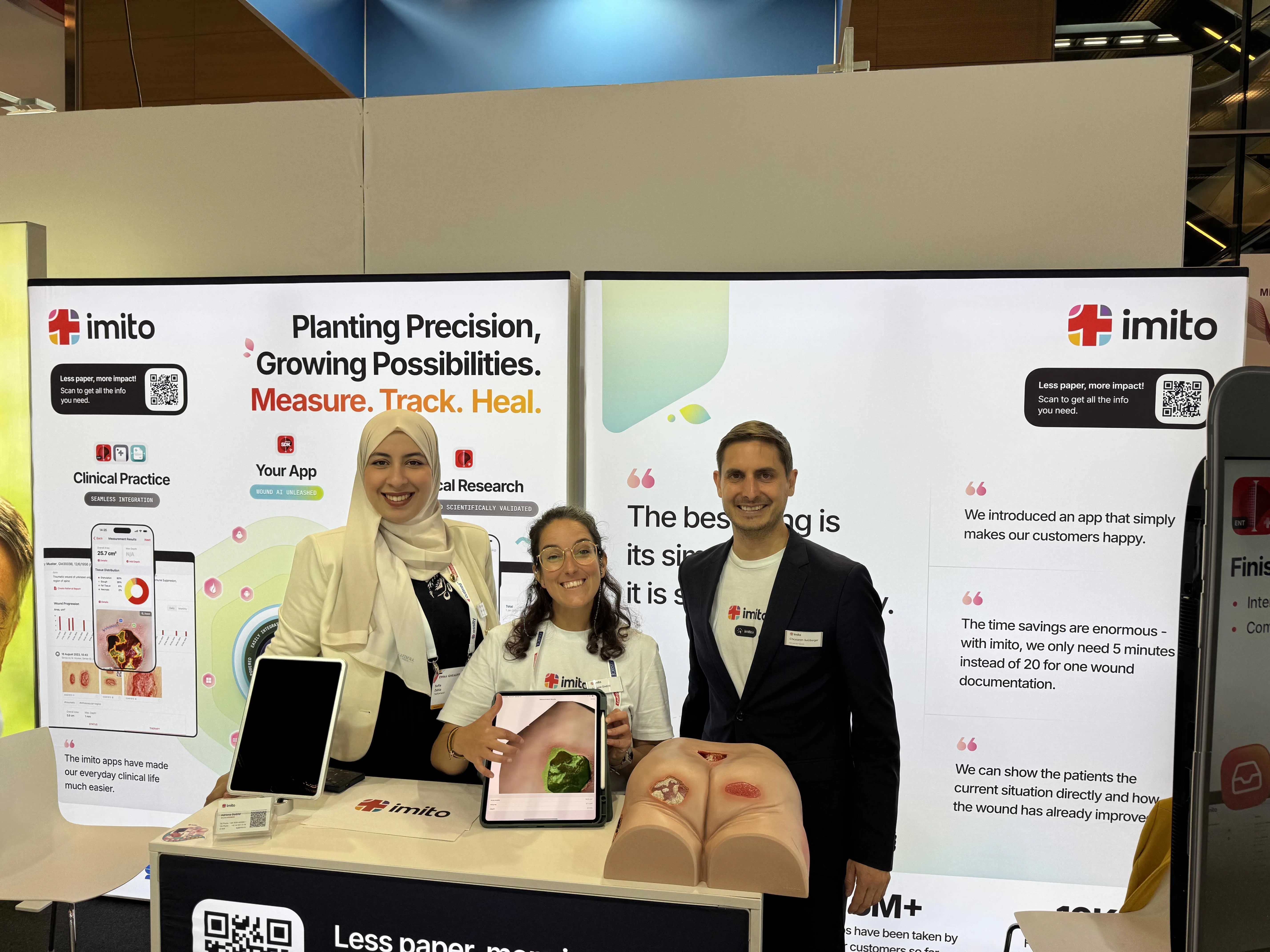

imito is integrated into ORBIS U Nursing - Germany's most used HIS

10 departments use imito - including vascular surgery

21 departments use imito - including the emergency ward
Here's what wound documentation looks like in many hospitals today: a photo on someone's personal phone, a handwritten note in one system, the measurement in another, and a PDF report that gets printed out because the digital version can't be shared. When that nurse calls in sick tomorrow, nobody can pick up the case seamlessly.
Back in 2015, Chrysanth Sulzberger, co-founder of imito, found in his master's thesis that 56% of healthcare professionals were already using their smartphones for clinical photo documentation - often sharing sensitive patient images through WhatsApp. Not because they don't care about data protection, but because there was simply no better option.
That's the gap wound care documentation software fills. One wound app on the device your staff already carries - photos, measurement, documentation and sharing in a single place. No additional hardware, no complicated setup, just a wound scanner on your smartphone, which makes everything available immediately in your EHR via any desktop computer.
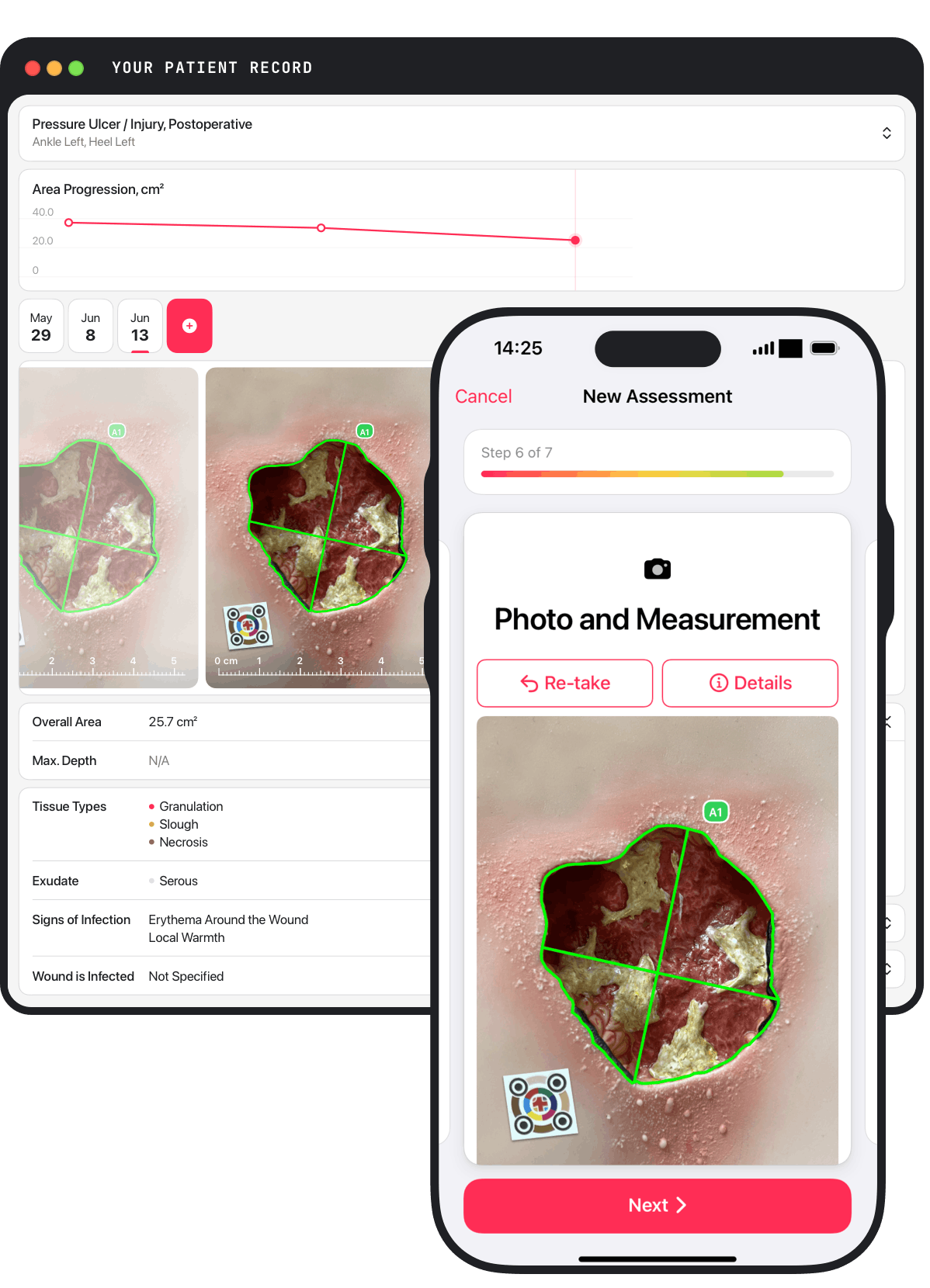
This is the part that makes many people go "wow" when we're at an event, according to Sofia Zahia, our Artificial Intelligence Engineer. With imitoWound, you place a small calibration marker next to the wound, take a photo, and our algorithm automatically detects the wound edges. Area, circumference, length, width - calculated in seconds, without touching the wound.
The algorithm behind this wound scanner has been trained on thousands of expert-checked wound images. It works regardless of skin tone and recognises multiple wound areas in a single photo. No tracing with your finger needed, no guesswork, no infection risk. If you want, you can still fine-tune the wound edges manually - but most users don't need to.
And it's not just theory: a study by Guarro et al. confirmed that imito's wound assessment tool is as reliable as the traditional ruler method. Researchers have even used it to measure wounds on elephants and cats.
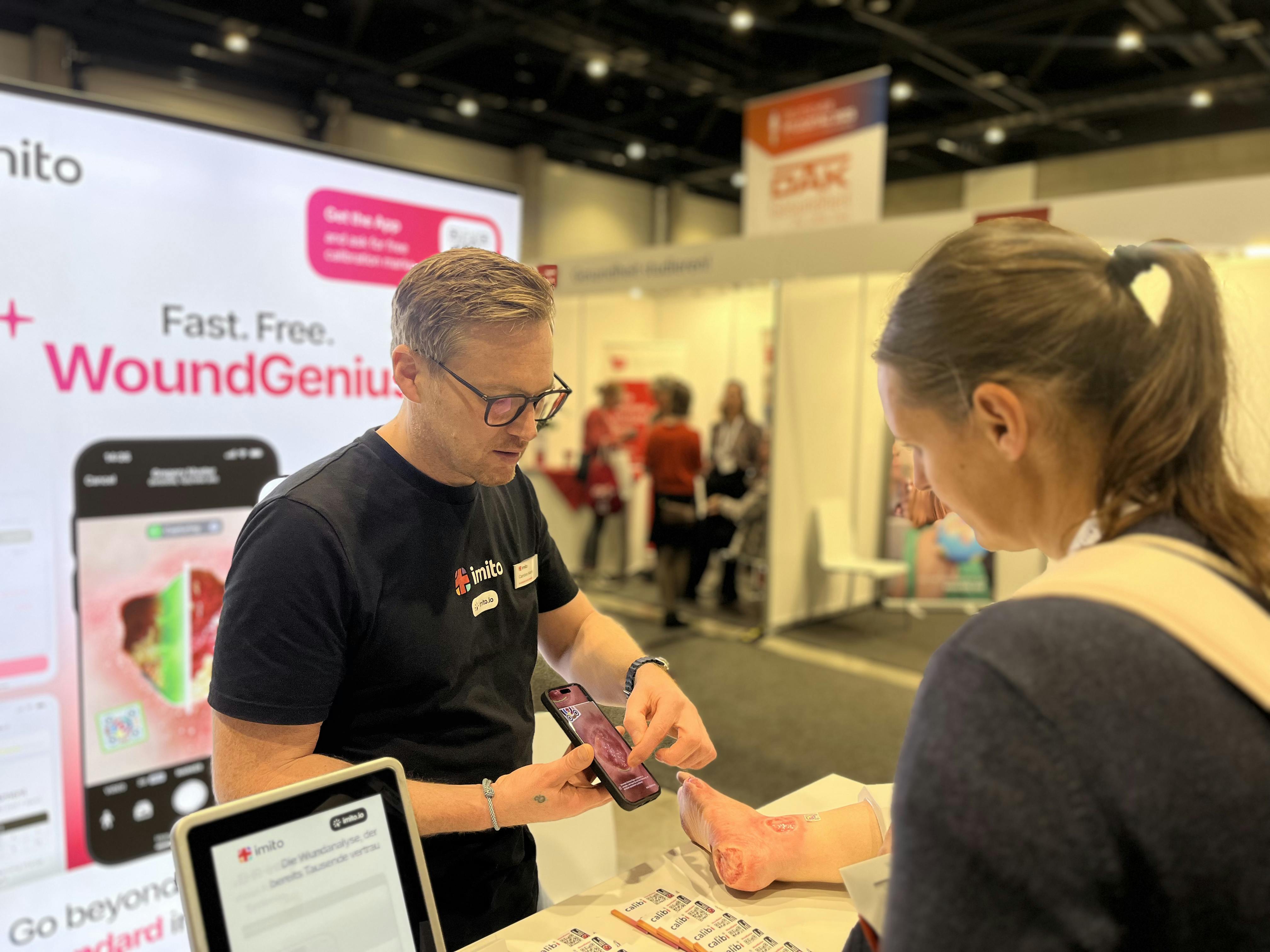
Numbers are nice, but let's talk about real hospitals. At Sana Kliniken Leipziger Land, the wound experts save 148 hours every month since switching to imitoWound. That's almost a full-time position - freed up for actual patient care instead of paperwork.
At ZURZACH Care, wound expert Petra Behne and her team went from 20 minutes to 5 minutes per wound documentation. Their old system couldn't even export or print reports - so they had to create an additional handwritten document every time a patient was handed over to a colleague.
And when we asked Jennifer Schomber, wound expert at Giessen University Hospital, if she would recommend imito to other clinics, she laughed: "What kind of question is that? Yes! Because it's uncomplicated and even inexperienced colleagues are guided through the menu very easily."
If you're a wound manager or wound care nurse, this is your daily tool. imitoWound gives you preset options for wound type, tissue types, exudate, wound edges and treatment - all based on expert standards. You select more than you type, which means your wound descriptions are standardised and your colleagues can pick up any case without guessing what you meant.
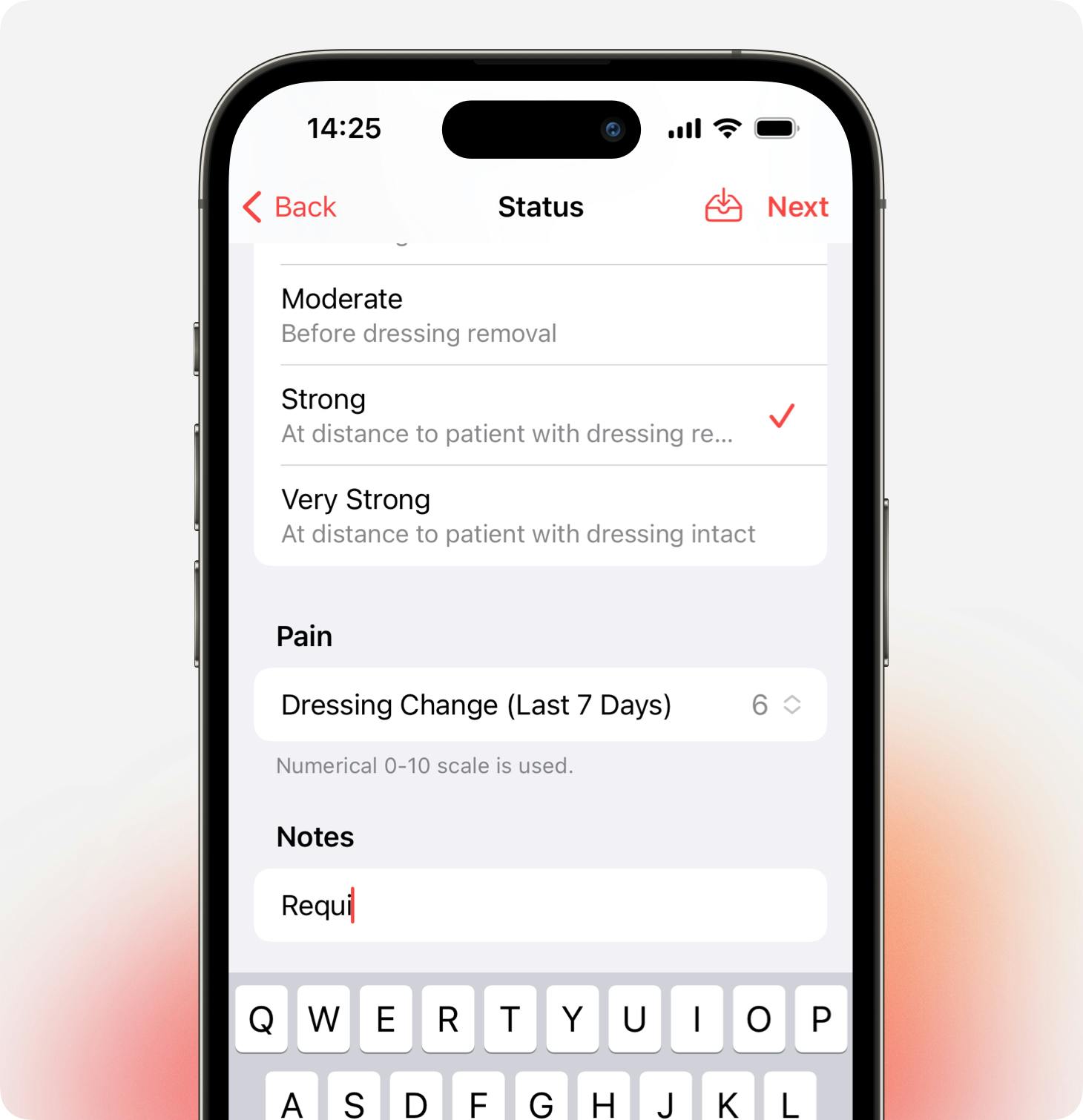
The wound app also lets you track the healing process visually on a timeline. Photos, measurements and documented parameters are all in one place - no more flipping between systems. And when you need to share a wound report with a referring physician or a follow-up care provider, it's exported as a PDF in a few clicks.
We also developed a supervisor mode, so senior wound managers can oversee documentation quality across multiple teams and locations - and help with difficult cases from anywhere.
If you're a nursing director, you know this reality: skilled staff are rare, their time is expensive, and a lot is lost to manual documentation instead of patient care.
Wound care software tackles this from two angles:
It makes your institution a more attractive employer. Nurses don't want to spend their shifts fighting with clunky documentation systems. When you give them intuitive digital tools, they spend more time with patients and less time on "busy work." In a market where every hospital is competing for the same talent, that matters.
Even non-technical staff can use imito right away - Ueli Wehrli from Hospital Winterthur put it this way: "User training for imito is basically non-existent, because the app is so simple and self-explanatory."
It standardises documentation across your entire team. When everyone selects from predefined options for wound type, tissue, exudate and edges, the result is consistent, comparable documentation that any colleague can understand at a glance. No more deciphering someone else's handwriting or wondering what they meant by "moderate redness." This also matters during audits - especially for pressure ulcers, where you need to trace back exactly what happened and when.
Clinic managers have different priorities - and wound care software addresses those too. Easier billing and audit protection. Precise, structured documentation of wound area reduction over time makes reimbursement smoother. But it also protects you during audits. When regulatory bodies want to see exactly what happened and when, you can pull up every photo, every measurement, every documented parameter - timestamped and linked to the right patient. A. Ahollinger from the Diabetic Centre Mergentheim put it clearly: accurate wound measurement is crucial to ensure reimbursement for diabetic foot ulcer patients, and during audits they can now provide comprehensive documentation.
One of the trickiest questions during an audit: did a pressure ulcer already exist on admission, or did it develop in your hospital? With paper-based documentation, that's often unclear. When documentation is digital and fast, staff capture a photo and measurement the moment a patient arrives - giving you timestamped proof of what was already there. At a facility level, imito's dashboards let you track existing and hospital-acquired pressure ulcers separately, spot patterns across departments, and see whether your prevention measures are actually working.

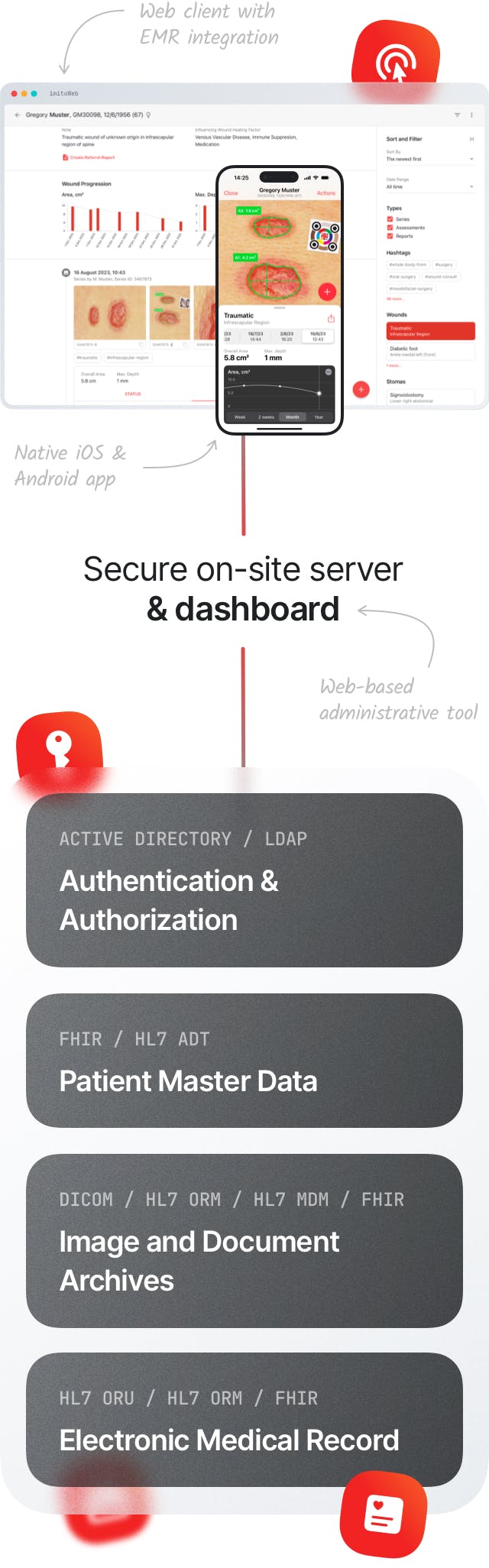
The biggest worry we hear from IT departments is: "But will it work with our EMR?" Short answer: yes. Over 70 hospitals already run imito's wound software integrated into their existing infrastructure via FHIR, HL7, LDAP, SAML and DICOM. And as of 2026, imito's wound measurement is natively integrated into Dedalus ORBIS U - the most-used hospital information system in Germany. After a successful pilot at Asklepios Klinik Langen, the solution is now available for all Dedalus customers.
For IT managers, there are a few practical things that matter: imito runs on any common iOS or Android device (no special hardware procurement), the IT maintenance is minimal with only one or two updates per year.
Our IT project manager team around Florian & Christoph always have an open ear if problems or questions arise. Florian has been working in hospital IT since 2009, previously at a software company for medical speech recognition. Christoph came from six years at a company that built cardiovascular documentation software - and is also a prolific producer of cinnamon rolls.
Ueli Wehrli, Head of ICT Applications at Hospital Winterthur, confirmed: "The IT maintenance required for imitoCam is minimal. These updates are well-prepared by the imito team and do not pose any issues for us."
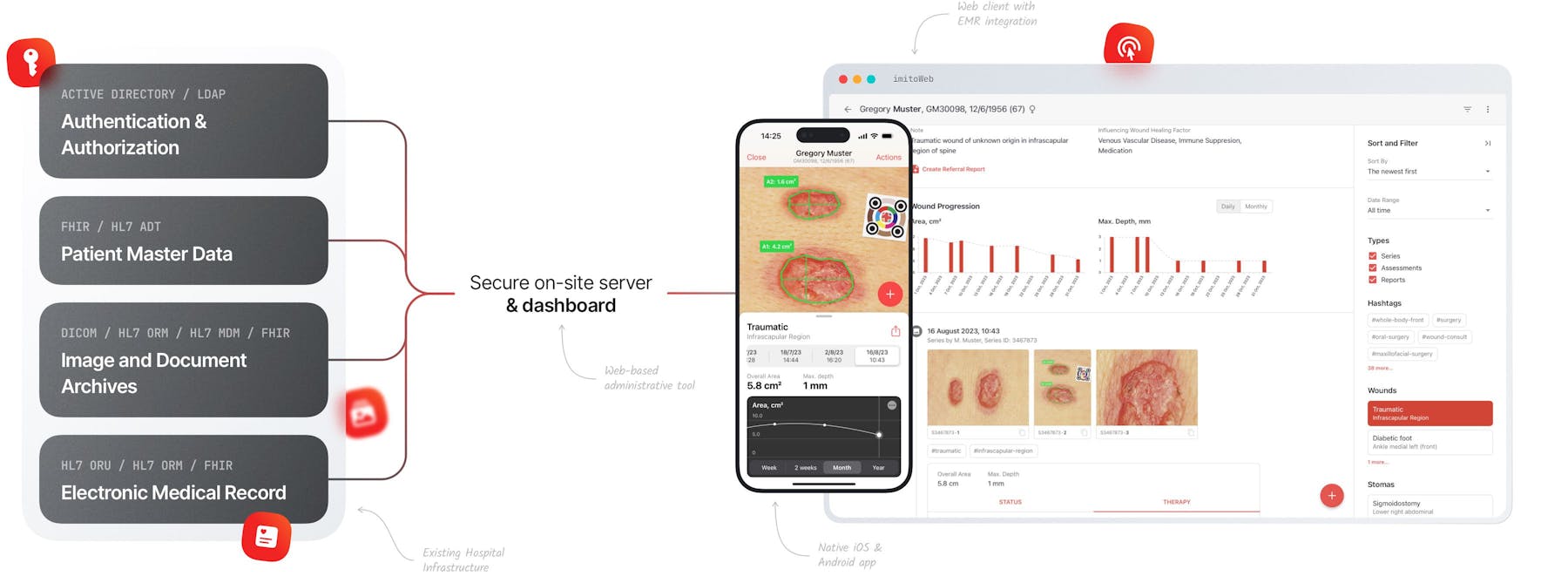
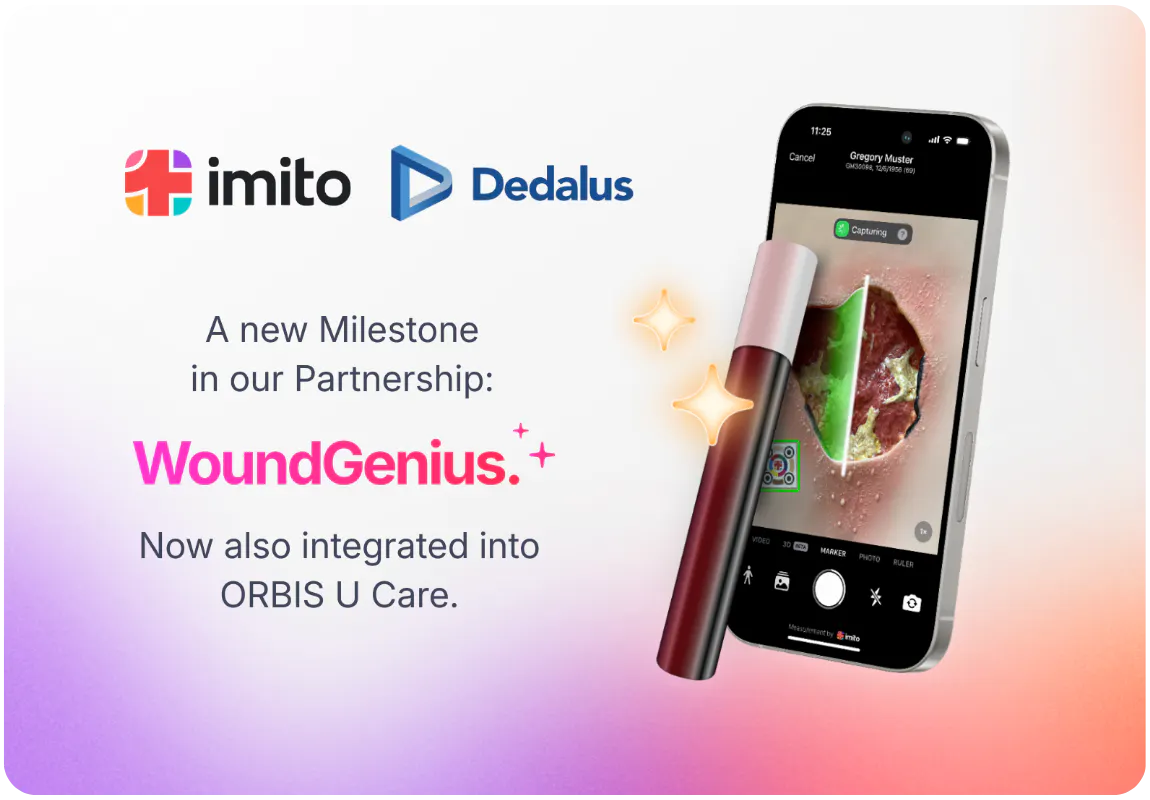
If you're a product manager at a medtech or healthtech company, you might not need a standalone wound care app - you need wound measurement inside your own product. That's what WoundGenius is for as it can be integrated as an SDK directly into your EMR or clinical platform.
WoundGenius brings imito's scientifically validated wound measurement and assessment directly into third-party applications. It supports calibration marker and ruler modes, automatic wound edge detection, and standardised documentation - all embeddable into your own workflow. Dedalus has integrated WoundGenius directly into ORBIS U, Europe's leading hospital information system.
If your team is building wound care management software, a telemedicine platform, or a clinical trial tool, there's no need to build wound measurement from scratch when you can integrate a method that's already been validated in clinical studies.
Today, wound care software from imito is used in over 35 different departments across 70+ hospitals - including vascular surgery, dermatology, emergency wards, neurology, geriatrics and many more. Beyond hospitals, clinical research teams at medtech companies use our wound measurement tool for their studies, because scientifically validated measurement is a must when you need to prove your hypothesis.
Whether you're a wound expert doing daily rounds, a nursing director looking to retain staff, a clinic manager tracking pressure ulcer statistics, an IT manager evaluating EMR integration, or a product manager looking to embed wound measurement into your platform - we're happy to chat and won't bite.
We use cookies to give you the best browsing experience possible.
Learn more about our privacy policy